

Minimalism in the Forest: Lessons in Stripping Away Ego and Excess

Minimalism as it is sold now is largely a look. Neutral palettes, empty surfaces, expensive objects photographed with a lot of space around them. It is an aesthetic of having enough money to choose scarcity.
The version embedded in the Ramayana's forest years is doing something different, and considerably less comfortable.
Reduction Without the Aesthetic
Ram, Sita and Lakshman leave with almost nothing. Bark cloth, weapons, each other. The reduction is not curated and it is not a preference. It is what remains after everything else has been removed by circumstance.
What the epic then does is quietly demonstrate that this was enough. Not comfortable, not desirable, but sufficient for a life that turns out to contain more of consequence than the palace years did.
The Distinction That Matters
There is a real difference between owning few things and needing few things, and the second is much harder.
A person can own fifteen items and still organise their entire sense of self around them. The reduction is cosmetic if the attachment simply relocates to a smaller number of objects.
What the forest sequence tests is not the count. It is whether identity survives when the objects that expressed it are gone. Ram is not a minimalist in any modern sense. He is someone whose sense of self did not depend on the throne, which is why losing it did not disassemble him.
Ego as the Actual Subject
The Sanskrit term worth knowing here is ahamkara, usually translated as ego but more precisely the I-maker: the faculty that takes experience and constructs a separate self out of it.
Ahamkara is not vanity. It is the ordinary and constant process of building an identity from your role, possessions, achievements and relationships. Everyone does it. The problem is not the process but forgetting it is a process, at which point every threat to the construction feels like a threat to existence.
Stripping away possessions does not touch ahamkara at all if the identity simply reattaches to being someone who owns little. That is the trap in aesthetic minimalism, and it is the same reason identity borrowed from a logo is a rented arrangement rather than an owned one.
What the Forest Actually Removes
The audience, since nobody in the forest knows or cares who he was
The role, which had defined him from birth and now describes nothing
The comparison group, without which status has no meaning
The objects that expressed position, now replaced by bark
The future he had organised his expectations around
Very little of that is about possessions. Which suggests the forest was never really testing his relationship to objects.
A Version You Can Actually Use
Nobody is recommending exile. But the underlying question transfers cleanly, and it is more useful than any decluttering method.
Take one thing you own that you would be embarrassed to lose, and ask what the embarrassment is about
Notice which possessions you mention to people and which you never do
Ask what you would still be if your job title vanished this afternoon
Try one day where you do not photograph or mention anything you did
Notice whether owning less has become its own identity
The last one catches most people who have been at this a while, ourselves included.
Why We Design This Way
Reduction in a garment is not about looking austere. It is about whether the piece can carry an idea without needing noise to prop it up.
A crowded print survives on volume. A single mark on an unbroken field has to actually work, which is why removing design costs more than adding it.
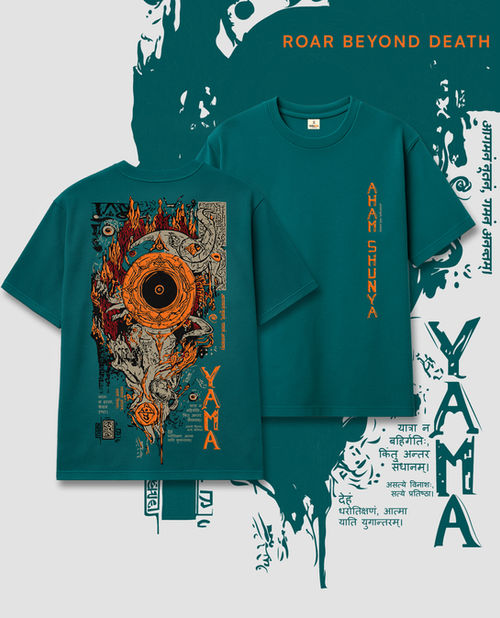
YAMA is the most stripped-back piece we make, named for the yamas, the restraints in Patanjali's system, because limit is what gives a thing shape. VANVAAS carries the forest version of the same idea.
The Point of the Reduction
Stripping away is not the goal in either the forest or a wardrobe. It is a method for finding out what was load-bearing all along.
What survives the removal was never the thing you were worried about losing.
Frequently Asked Questions
What does the Ramayana teach about minimalism?
That the meaningful test is not how little you own but whether your identity survives when the things that expressed it are gone. Ram's sense of self did not depend on the throne.
What is ahamkara?
Usually translated as ego, more precisely the I-maker: the faculty that constructs a separate self out of role, possessions and achievement. The issue is forgetting it is a construction.
Is minimalism the same as owning fewer things?
Not necessarily. Owning few things while organising your identity around them relocates the attachment rather than examining it. The count is easier to change than the dependence.
How does forest exile relate to modern minimalism?
The forest removes audience, role, status and future expectation rather than mainly possessions, which suggests it tests attachment to identity rather than to objects.
Discover how silence can speak through design. Explore our latest streetwear collections where ancient wisdom meets modern minimalism. Each piece embodies mindful fashion, Indian inspired streetwear, and the spirit of Shunya Theory.
👉 ARKA spiritual streetwear inspired by the Sun's energy
👉 YAMA fearless minimalism rooted in ancient philosophy
👉 VANVAAS self-discovery through solitude and design
👉 WARLI Indian heritage streetwear with tribal art essence


.png)


Comments